
होमAsian Cricket22 balls of doom in gloomy Mirpur: Bangladesh top order crumbles, hopes rest on lower order
22 balls of doom in gloomy Mirpur: Bangladesh top order crumbles, hopes rest on lower order
मीरपुर में वेस्टइंडीज़ के खिलाफ पहले टेस्ट के तीसरे दिन बांग्लादेश का शीर्ष क्रम 22 गेंदों के भीतर चार विकेट गंवाकर 35 रन पर पांच विकेट की स्थिति में पहुंच गया। रोस्टन चेज़ ने 10 गेंदों में तीन विकेट लिए। दूसरे ही टेस्ट में खेल रहे तौहिद हृदय ने अपनी पारी की दूसरी गेंद पर बड़ा शॉट लगाकर विकेट गंवाया। ओपनर टंज़िद हसन का यह 10 पारियों में तीसरा शून्य रहा। मोमिनुल हक को फील्डिंग के दौरान सिर में चोट लगी और जाकर अली को कॉन्कशन सब्स्टिट्यूट बनाया गया। जाकर अली और नईम हसन के बीच सातवें विकेट के लिए 26 रनों की साझेदारी हुई, और बांग्लादेश ने लगभग 106 रन की नाजुक बढ़त बनाई। लगातार तीसरे दिन खराब रोशनी के कारण खेल रुका, जिससे ड्रॉ की संभावना बढ़ी। यह बांग्लादेश की शीर्ष क्रम बल्लेबाजी की संरचनात्मक कमजोरी को उजागर करता है।
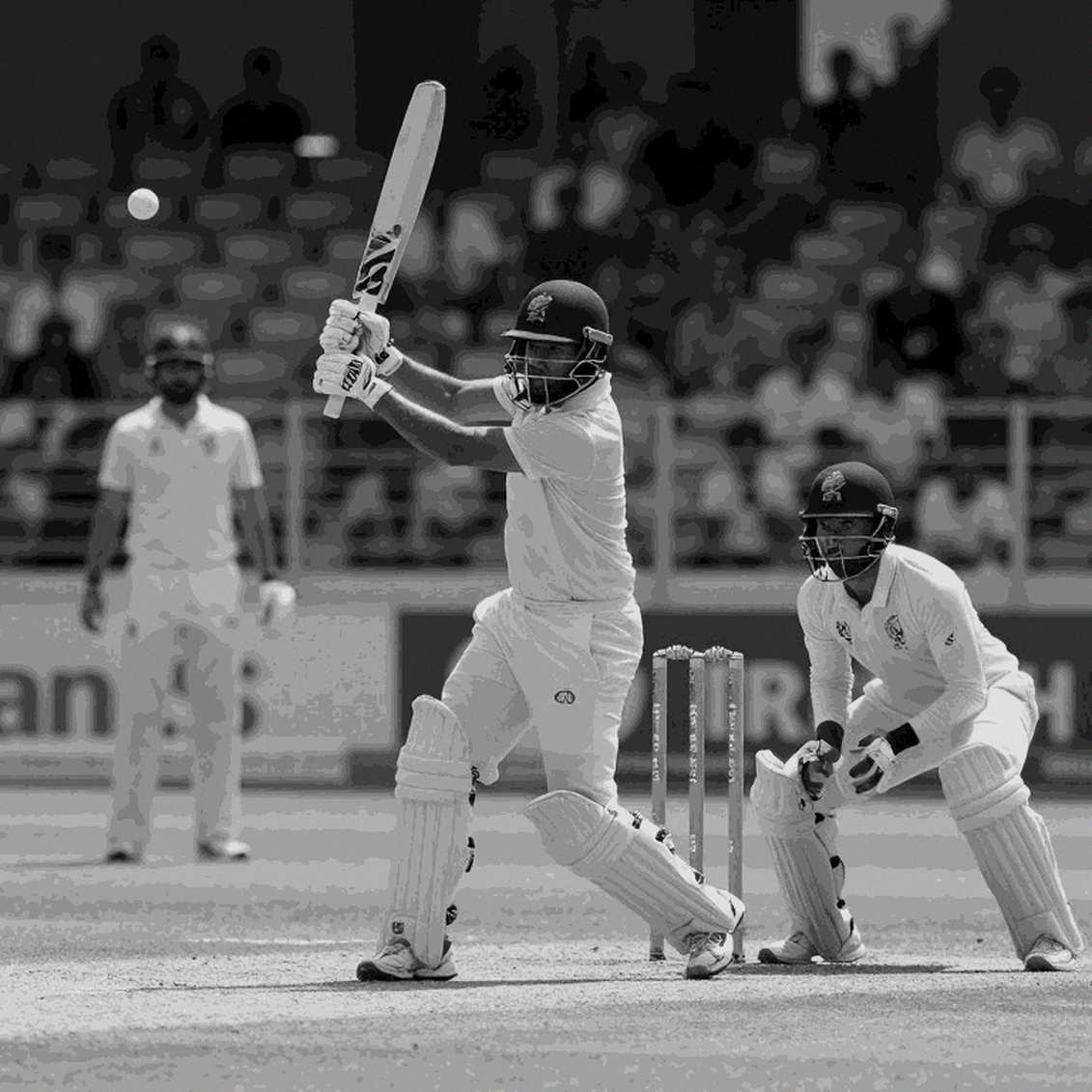
Mirpur: When the first session of Day 3 of the first Test against West Indies began at the Sher-e-Bangla National Stadium, hosts Bangladesh had a golden chance to strengthen their lead. The pitch was already favourable to spinners and the team held a respectable advantage. But what unfolded stripped bare the fragile foundations of Bangladesh's batting. Four wickets fell within just 22 balls and the team slumped to 35 for 5. For any Test side to lose five wickets for 35 at home is nothing short of a sporting disaster, and it exposed a clear lack of both technique and temperament in the Bangladeshi top order against the turning ball.
The top order collapsed one after another. Shadman was bowled, while Shanto and Litton Das were both trapped LBW. The ball was sometimes turning sharply, sometimes keeping low, and occasionally bouncing abruptly—leaving the batters no time to settle. This was a surface where even defensive technique fails. West Indies' spinners exploited it fully. Roston Chase turned the match on its head with three wickets in just 10 balls, while left-arm orthodox spinner Jomel Warrican chipped in with important scalps. Together they proved that spin was the decisive weapon on this pitch.
But the central and most debated point of the day was unmistakably Tawhid Hridoy. On one hand, senior batter Mominul Haque was forced off with a head injury sustained while fielding, and Jaker Ali was brought in as a concussion substitute. On the other, team management handed the huge responsibility of the No. 4 slot to Tawhid Hridoy, a batter playing only his second Test. The No. 4 position is regarded as one of the most important in Test cricket—a settled, technically sound, experienced batter normally occupies it. Yet Hridoy, with barely two Tests behind him, was thrust into it under pressure. And when he attempted a big shot on only the second delivery he faced, eyebrows went up everywhere. This 'wild heave' came when the team was reeling at 35 for 5, and a risky shot was played to open the account. It was not a technical failing but a serious decision-making error, itself a product of handing a big role to an inexperienced player.
Nayeem Hasan later commented on that shot, saying he did not know what was going through Hridoy's mind, because he himself is a lower-order batter and was preparing to bat. That statement carries deep meaning. First, it suggests he had no chance to observe the top-order decision during the collapse, meaning senior players' intervention at this crucial juncture in the dressing room was probably limited. Second, it reveals what kind of leadership the Bangladeshi team needed to handle the gravity of the situation—and which was not available.
Looking at Nayeem's batting philosophy, he said that 'you have to keep the scoreboard ticking, that is the only way to put the bowler under pressure.' On a turning pitch this is a legitimate cricketing philosophy—you cannot survive by pure defence for long and must score to force the bowlers to earn your wicket. But this philosophy cannot justify Hridoy's shot. The line between smart aggression and reckless heaving is fine but real. Hridoy crossed that line.
Now to opener Tanzid Hasan. This is his third duck in ten innings—meaning he was dismissed without scoring in 30 per cent of innings. For a Test top-order batter, this rate is unsustainable. This is not merely a form slump but a signal of a serious problem with his technique and shot selection against the new ball. It is a repeatable risk, distinct from the ups and downs of form, and without correcting it, surviving at the top of a Test order will be difficult.
The single biggest blow for Bangladesh in this match was Mominul Haque's injury. A blow to the head while fielding removed the senior batter and triggered the whole concussion-substitute chain. Jaker Ali replaced Mominul. This is a relatively new ICC rule (introduced in 2026) and its use can alter the match balance. Bangladesh gained a like-for-like middle-order batter, strengthening them—but it is equally true that losing an experienced player dented morale. The event was not isolated but a chain reaction—senior batter injured, an inexperienced player pushed to No. 4, and the whole order crumbling.
Now to the surface and weather. The Mirpur pitch has traditionally been low, slow and turning. West Indies coach Reifer even said that 'you can't bat for survival on a pitch like that.' This means that for both teams' batters, the pitch makes conventional defensive play difficult and scoring becomes essential.
But the match's biggest obstacle is not cricketing but meteorological—lack of light. Play was halted due to bad light for the third consecutive day. This is not a one-off but a recurring structural problem, pointing to early dusk or overcast conditions at Asian venues like Bangladesh. When the equivalent of multiple sessions of overs are lost to bad light in a Test, the likelihood of a result is seriously compromised. If overs keep being lost, the probability of a draw rises, unless a big collapse reopens the game.
Looking at the current state, after Bangladesh had lost five wickets for 35, Jaker Ali and Nayeem Hasan shared a 26-run seventh-wicket stand that gave the team some support. Bangladesh were roughly 106 runs ahead overall. This position is fragile, not commanding. To set a match-winning target from 35/5, the lower order must more than double the lead—no easy task.
Looking at the broader picture of both teams, they sit in the lower half of the Test rankings and are typically outside World Test Championship final contention. Bangladesh is historically strong at home on turning pitches but prone to collapses. Losing five wickets for 35 at home exposes a structural weakness in the top order—this is the first such instance since 2026 and only the third at home. It is a pattern, not an accident.
Bangladesh captain Najmul Hossain Shanto was among the dismissed batters. But the dimension of leadership during the collapse remained under-examined. Such a collapse at home raises the question of whether adequate leadership was present in the dressing room.
As for West Indies, the spin pairing of Roston Chase and Jomel Warrican proved that spin is decisive on the Mirpur pitch. Chase is primarily a batting all-rounder who bowls off-spin; his three wickets in 10 balls on a low, turning Day-3 pitch are surface-favourable figures rather than proof of extraordinary spin craft.
It must also be remembered that this is not just about one innings. Nayeem Hasan, the 'hero with the ball' in West Indies' first innings, is now the team's batting hope. This illustrates the thin wall between Bangladesh's bowling and batting personnel—on a turning pitch one player must play both roles.
This whole sequence reveals a bigger picture of Bangladeshi cricket. The top-order collapse on home turning pitches, pushing a two-Test batter to No. 4, and an opener with a 30 per cent duck rate—all point to a serious gap in Bangladesh's first-class and batting-development system.
In terms of broader risks, the biggest is the repeated fragility of Bangladesh's top order (35-5, Tanzid's three ducks in 10). This is a structural issue to monitor through the series. The second big risk is Mominul's injury and his return timeline, which will affect middle-order balance. The third is the loss of overs to recurring bad light and weather, raising draw probability. The fourth is public and selectoral over-reaction to Hridoy's shot—which could have a long-term effect on a young player's career, so his inexperience and forced promotion must be weighed.
In conclusion, Day 3 of the Mirpur Test sends a clear message about the fragility and lack of depth in Bangladesh's top-order batting. This is not the fault of one player but a systemic problem—pushing young batters into big roles before they are ready, struggling with injuries, and repeated collapses. It is not a verdict on West Indies' superiority but a mirror of Bangladesh's own weaknesses. The result now depends on how strong a target the lower order can set and how much the weather cooperates. If the loss of light and overs continues, even a competitive contest's result could fall victim to the light—and that would be a serious concern for Test cricket.
संबंधित खिलाड़ी
अनुशंसित
The Rain-Soaked Auckland Chase: How a 143-Run Target Redefined Kohli's Percentages2026-11-05
The Lesson of the Empty Notebook: When the Analysis Pipeline Becomes the Story2026-11-04
Khawaja's 8-Year Silence: Why the Sandpaper Gate Truth Emerged Now2026-11-09
The Empty Payload: Cricket Analytics' Most Dangerous Number Is the One That Never Arrived2026-11-09
Phillips's century as New Zealand finally stop India — an 87-run win2026-10-31
अनुशंसित
Bangladesh Roller Skating Federation: A 29-Member Ad Hoc Committee and the Same Old Sports-Administration Prescription2026-11-11
8.4 Million vs 8 Million: India-Pakistan Ticket Battle Outdraws World Cup Final, But Margin Is Only 5%2026-11-03
Sylhet Test: Darren Sammy's 'Hunger' Statement and West Indies' Dream of a Series Win2026-11-03
Ranji's Empty Stairs, IPL's Glowing Scoreboard: Indian Cricket's Real Partition Happens in the Boardroom2026-11-04
The Asia Cup Expanded, and Asia's Domestic Grounds Shrank2026-11-06